

Kyiv Post got exclusive insight into Ukraine’s expanding drone program, uncovering the technologies, assembly methods, and testing processes behind the unmanned systems countering Russia’s invasion.
June 21, 2025


The modern Russo-Ukrainian war is changing all the rules on the battlefield.
While in 2022 traditional means of destruction — aviation, artillery, tanks — played a key role, now everything is different.
The main strikes are carried out by drones, which have de facto replaced artillery and, partly, cruise missiles, and now fulfill the roles of both infantry and mortar units.
Drones — a cheap yet extremely effective product — are effectively nullifying all previous military experience. A successful operation by Ukrainian special services to destroy Russian strategic aviation shows that drones can be used virtually anywhere, under virtually any conditions, to hit virtually any targets.
This is an entirely new war, and since 2022 its tone has been set by Ukrainian engineers, enthusiasts, and military personnel.

An engineer and founder of his own drone manufacturing company, he now produces thousands of UAVs for the Ukrainian army every month in western Ukraine. It is in factories like this that Ukraine’s victory is being forged.
Why drones?
Malyshev told us “I’m from the Luhansk region and studied at the Sevastopol University of Nuclear Power Energy – Crimea was not occupied at the time; it was under Ukrainian control. Drones were a hobby at my university; we created some projects using solar technology. When war came, I decided to help to make some small drones for our military.”

Gradually, he realized the value of drones and decided to start production in earnest, with new models and his first employees appeared – now they have a real, industrialized production line.
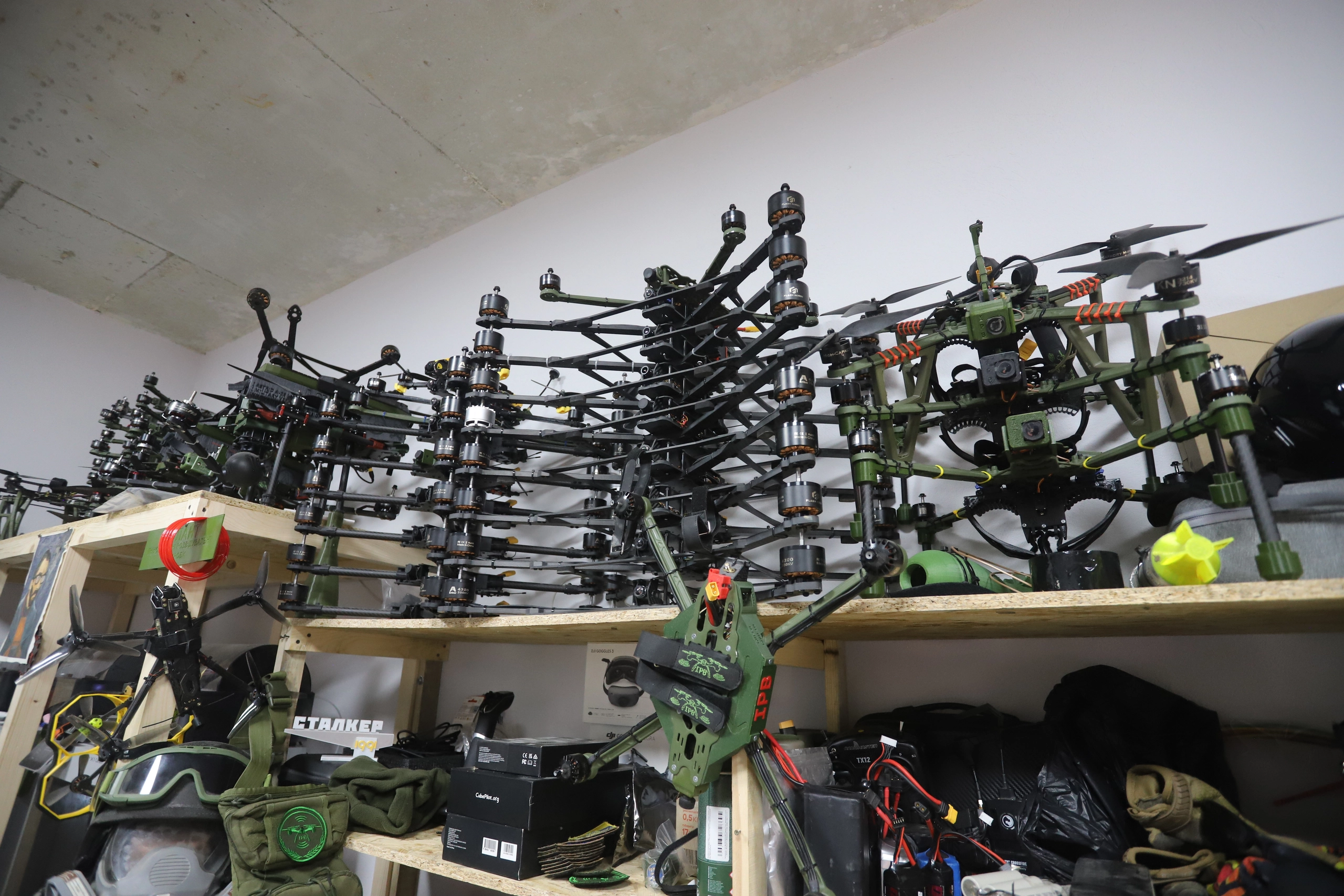
“We have 25 people in our company, we could produce 6,000 drones per month, but because of the range of models we make we’re limited to 1,500 now. We make 10-inch, 13-inch, multiple-use drones, [First-Person-View] FPV kamikaze drones – we now produce more one-way use model. We also provide support on the front line – if something breaks whether by operator error or a production fault, we’ll be there to repair it.”
“And we respond to feedback from the military – what works, what doesn’t, please bring a higher antenna or a different operating frequency antenna – no problem,” Malyshev says.
Production kicks off on 3D printers, which are used to make the frame of the drone and certain components.

If needed, the frame is made from a duralumin alloy – the company can also produce metal parts itself.
“The most popular models are our 10-inch and 13-inch multiple use drones. They operate on different frequencies, use different video control, and a variety of frames. Our duralumin frames are cheap to produce. Our drones have multiple uses and can carry up to 5 kilograms [11 pounds]. 42 brigade used a one of our drones to carry a 2.5 kilos (5.5 pounds) over 35 kilometers [22 miles] – a record,” Malyshev says.

Next comes “packaging” – a complex process that has to be adjusted for each specific type of UAV – to ensure the flight controller, motors, cameras and so on arrive in one piece. Previously mainly imported Chinese components more and more are being produced in Ukraine, which has become important, because now a de facto a partner of Russia, future access to Chinese parts is becoming more difficult and may stop altogether.

“We made big progress in 2024 – we can now produce our own frames, but have to source larger motors outside of the country as Ukrainian manufactured motors are too small but Ukrainian manufacturers can produce speed and flight controllers. All the drones you see here were made with UA-made controllers. The drones that attacked Russia’s strategic aviation were made of our parts.”
“We need to source the best digital links and cameras but very few Ukrainian companies produce the quality of thermal and digital equipment we need, which I won’t name because it could be dangerous for them. We have made huge progress, but we need more,” he said.
Andrii Belchev, one of the company’s engineers showed us examples of Chinese and a Ukrainian circuit boards telling us the domestic version offers better performance and is more reliable.
“This “drone brain’ chip is Chinese, the other is a Ukrainian one made by the “Tykho” company. All electrical contacts are pre-prepared. They copied the Chinese model but improved its barometer and gyroscopes,” Belchev said.

All these details are important, as each drone model is built for different tasks. One example is an FPV kamikaze drone — a one-time-use unit. Another can be used as a reusable bomber, for reconnaissance drone, logistic carrier, and so on.
“A Bomber drone is not one-way; it is a digital system based on different systems including DJI and Walksnail. We produce plastic housings for the camera, that allow it to look down when dropping the item, with either a one or two drop system and an antenna to boost the signal”

We also have a 17-inch drone fitted with both a thermal and conventional camera that the operator can switch between. If in flight you can’t see a target in a wooded area for example, then switching to the thermal camera reveals the enemy. The flight controller and the “brain” are Ukrainian made,” Malyshev tells us.

The drones they produce are used in operations by several dozen units. His engineers constantly train soldiers and test new drones – on their own training ground.

Once the drone’s electronics are fully assembled, the software must be reflashed, and all contacts checked to make sure everything is connected correctly and functioning properly. This is Andrii Belchev’s job.
“Everything has to work perfectly, all details, buttons, switches, controllers, displays and glasses. After the checks I put my inspection mark, and we send the drone to the customer. Ideally, we should fly the drone but now it’s more difficult” Belchev says showing us the process.

But they don’t stop there. Development is constant Malyshev tells us. Some drones already in production can track their location automatically – they can return or strike a target without operator guidance, without the need for GPS, navigating by comparing the terrain with images stored in the on-board computer, making them more resistant to electronic warfare countermeasures.
Andriy and his wife’s motivation to continue the work each day, like that of every employee, is personal. Their whole family is fighting.
“All of our family – military men. Brother, sister, father, who is dead already. One of my relatives is POW now. So that’s why we started drone production. I convinced my husband to start our own production. It started with just the two of us before we hired our first workers.”
“I organize the process, communicate with military units, buy what we need for production, hiring personnel,” Olha, Andrii’s wife, explains her part.

Drones in modern warfare, says the company founder, are not just a new means of striking the enemy – they offer a shortcut to victory, a way to save strength and lives.
What Ukraine is doing is defending the civilized world from Russian aggression. And that’s why Ukrainian drone manufacturers, like Ukrainian soldiers, need continued support from the civilized world.

“We need to move more quickly, because the enemy has a lot of manufacturers. It’s like a race. Those who have more drones have a better chance of succeeding.”
“We’re losing people –we need more technology, more solutions, more help from you, because rockets are coming, planes are coming, the war is not yet over. It was a day, then a week, a month, now it’s five months, and the war is not over,” Malyshev says.
All Photos by Sergii Kostezh, Kyiv Post

https://www.kyivpost.com/post/54745