

April 16, 2026 10:40 pm
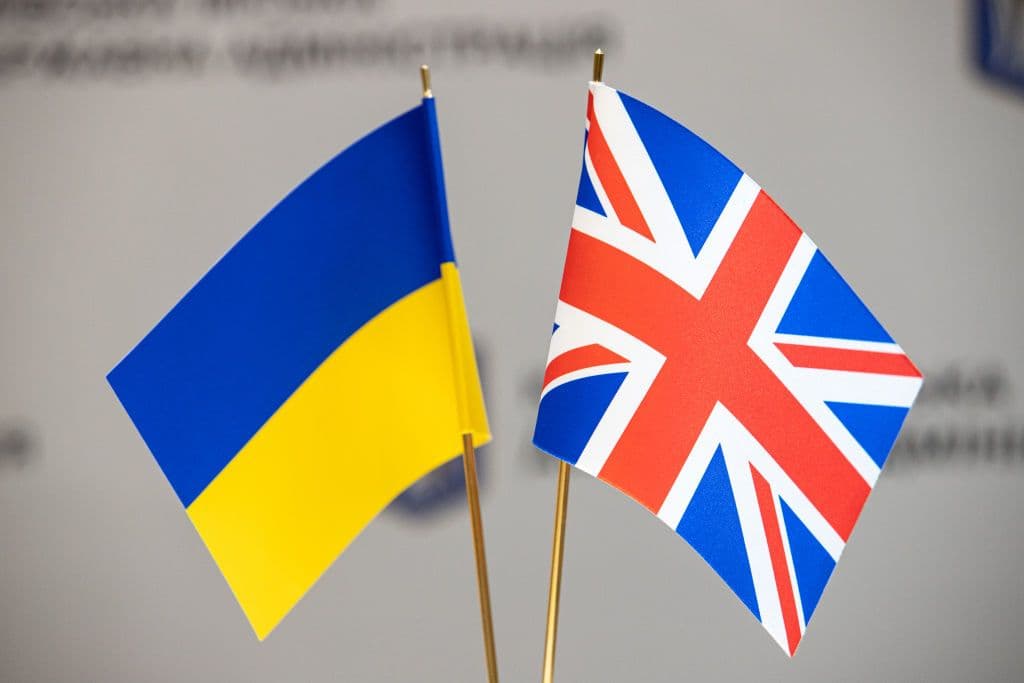
The flag of Ukraine and the flag of Great Britain are seen next to each other on Dec. 9, 2022 in Kyiv, Ukraine. (Oleksii Samsonov/Global Images Ukraine via Getty Images)
The United Kingdom has transferred 752 million pounds (about 1 billion dollars) in frozen Russian assets to Ukraine, Ukraine’s Finance Ministry said April 15.
“Ukraine has received the latest tranche from the United Kingdom in the amount of 752 million pounds sterling (about 1 billion U.S. dollars) as part of the G7 Extraordinary Revenue Acceleration for Ukraine (ERA) initiative,” the ministry said in a statement.
Finance Minister Serhiy Marchenko said the funding would address urgent needs in Ukraine’s security and defense sector.
“I am grateful to the Government of the United Kingdom for its consistent and resolute support for Ukraine in countering Russian aggression in the fifth year of full-scale war. The funding provided is targeted and will be directed to meeting the priority needs of the security and defense sector,” Marchenko said.
The latest payment is part of a broader agreement between the United Kingdom and Ukraine to provide Kyiv with 2.26 billion pounds (about 3 billion dollars) for defense needs. Ukraine previously received two tranches totaling 1.5 billion pounds in March and April 2025 under the agreement.
The assistance is part of the Group of Seven’s (G7) ERA initiative, a 50 billion dollar loan program that uses profits from frozen Russian sovereign assets to finance Ukraine and repay the loans.
Since Russia’s full-scale invasion in 2022, G7 countries have frozen approximately $300 billion in Russian sovereign assets.

………..
Another Orban? Here’s why you should care about Bulgaria’s upcoming elections
April 16, 2026 5:55 PM
A new Russian-friendly leader may soon emerge in the EU and NATO — this time, in the Balkans.
A week after Kremlin ally Viktor Orban lost his reelection campaign in Hungary, Bulgaria‘s former President Rumen Radev is poised to win the April 19 snap parliamentary election.
Radev, Bulgaria’s two-term head of state, resigned in January to lead his new Progressive Bulgaria coalition into the country’s eighth parliamentary elections since 2021, quickly surging in the polls.
As president, Radev has repeatedly diverged from Sofia’s pro-Ukraine line by opposing military aid for Kyiv and sanctions against Russia.
Hungary has proven that a single member state can hold the entire EU hostage — raising concerns that Bulgaria could become the next spoiler if Radev comes to power.
Who is Rumen Radev?
A former air force officer, Radev was first elected president in 2016 with the support of the Bulgarian Socialist Party (BSP), an heir to the Cold War-era Communist party.
Though Bulgaria’s presidency is largely ceremonial, Radev used his office to lambast support for Ukraine amid the all-out war with Russia.
The former head of state has criticized Western sanctions and said military aid to Kyiv prolongs the conflict, a stance that landed him in a heated exchange with President Volodymyr Zelensky in Sofia in 2023.
More recently, Radev denounced Bulgaria’s 10-year security deal with Kyiv, signed by caretaker Prime Minister Andrey Gyurov.
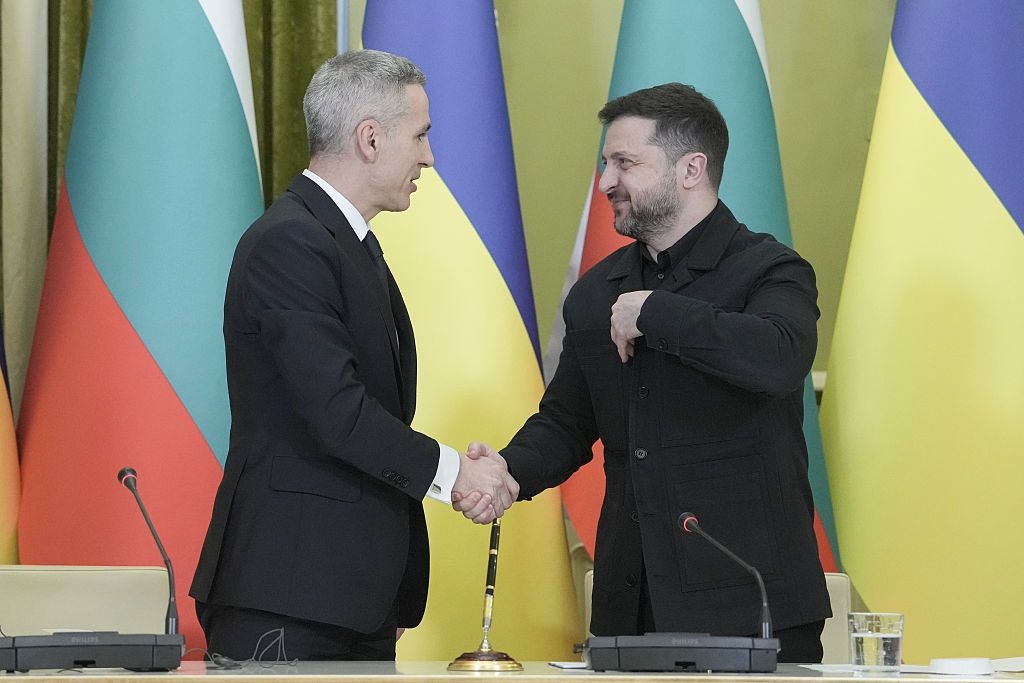
The ex-president is “a pro-Russian politician,” and “there is a great concern that he may try to steer the country away from its pro-European line,” Emilia Zankina, a professor at Temple University Rome, told the Kyiv Independent.
Previously, Radev pitched a controversial referendum seen as an attempt to delay the country’s entry into the eurozone, and a caretaker government he appointed allegedly tried to hamper plans to reduce Russian energy dependence in 2022.
The then-president — unsuccessfully — also attempted to veto a 2025 bill on tightening oversight over the sale of the Burgas refinery, the country’s largest oil facility owned by Russia’s Lukoil.
Ruslan Stefanov, an analyst at the Center for the Study of Diplomacy (CSD), a Sofia-based think tank, suggests calling Radev “pro-Russian” may be going too far — but acknowledges his stances make him seem “politically useful to the Kremlin.”
Radev is a “politician of considerable strategic ambivalence toward Russia” who has “tried to cater to extreme Euroskeptic, and typically also pro-Russian, voter groups,” Stefanov told the Kyiv Independent.
These views provided an opening for Radev’s pro-European opponents, who warned he could become a Trojan horse within the EU, similar to Orban.
According to Stefanov, it is unlikely Radev would become as “structurally powerful” as Hungary’s outgoing leader.
Bulgaria’s political system remains too fragmented, and no single party is likely to govern alone.
“The main risk is not that Bulgaria suddenly becomes a second Hungary overnight,” the expert argues, “but that a Radev-led government could obstruct, delay, dilute, or rhetorically undermine common EU and NATO positions” on sanctions, military aid, and more.
Zankina agrees, noting that while Radev holds similar — though more “moderate” — views to Orban’s, he is unlikely to secure comparable parliamentary support.
His party, she adds, may not even last long in Bulgaria’s volatile environment.
Who else is running?
Bulgaria’s past five years have been marked by a fragmented parliament, weak governments, and corruption scandals.
In comes Radev, leveraging broad dissatisfaction with the economic situation and oligarchic influence to jump-start his own parliamentary campaign after protests toppled Rosen Zhelyazkov’s cabinet.
Radev’s Progressive Bulgaria coalition, made up partly of former socialist politicians and Radev’s loyalists, leads the polls with about 30%.
“(Radev) manages to combine an anti-corruption (platform) with pro-Russian attitudes, and therefore he’s gathering votes from across the political spectrum,” Zankina said.
The GERB-Union of Democratic Forces (SDS) coalition, a center-right populist alliance led by former Prime Minister Boyko Borisov, comes in second with about 20%.
Borisov, a seasoned politician dogged by corruption and clientelism allegations, has maintained Bulgaria’s pro-Western stance — but he is also seen as a pragmatic populist.
Under Borisov, GERB has largely supported military aid to Ukraine. Yet, Borisov backpedaled on his support for a security deal with Kyiv in 2024, suggesting the agreement would not contribute to U.S.-led peace efforts.
We Continue the Change – Democratic Bulgaria (PP-DB), a pro-European, Ukraine-friendly coalition, comes third with about 12%.
The Movement for Rights and Freedoms (DPS), a Turkish minority-interest party led by U.S.- and U.K.-sanctioned oligarch Delyan Peevski, and the ultranationalist, pro-Russian Revival party are also expected to enter parliament.
The socialists are hovering around 4%, the threshold for entering parliament.
“From a tactical standpoint,” Radev has many options for coalition talks — but all with “considerable downsides” and likely to face heavy opposition in the parliament, Stefanov says.
Russian influence fears
Elections across Europe have increasingly turned into a battlefield for Russian influence.
The Bulgarian Foreign Ministry set up a unit to combat disinformation and hybrid threats ahead of the high-stakes vote, and tapped investigative journalist Christo Grozev as an advisor.
As an EU diplomatic service spokesperson told the Kyiv Independent on April 2, Sofia has been coordinating counter-interference efforts with European partners.
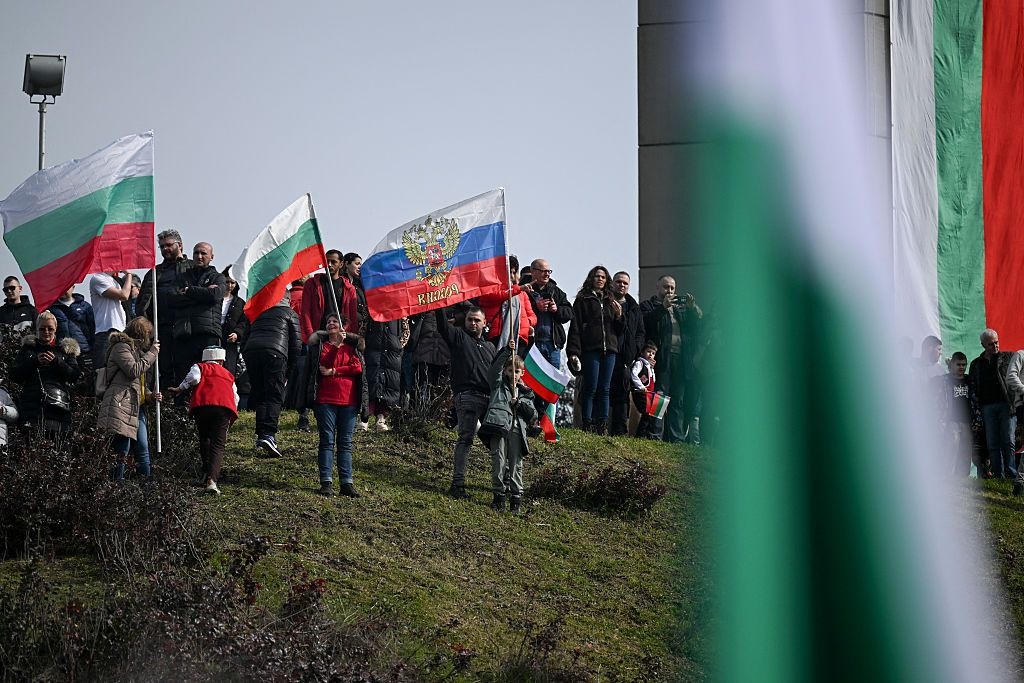
Radev pushed back, framing these efforts as a plot by the government and Brussels to compromise the elections.
He drew comparisons to Romania’s 2024 presidential vote, which was annulled amid suspicions of a massive Russian-led meddling in favor of ultranationalist Calin Georgescu.
In Bulgaria, years of political chaos and weak institutions have created a fertile ground for Russian interference.
Moscow’s influence in the Balkan country is “serious, longstanding, and deeply embedded,” Stefanov says.
Compared to some of their EU counterparts, Bulgarians — a predominantly Orthodox, Slavic-speaking nation — have held relatively more positive attitudes toward Russia.
While Sofia has supplied Kyiv with Soviet-era arms since 2022, the support has been kept secret for a time due to fears of political fallout.
About 31% of Bulgarians view Russia positively, and 50% negatively, according to an August 2025 survey by the Myara agency.
In turn, only a quarter of respondents had a favorable view of Ukraine, compared with 55% who held the opposite view.
However, long-term trends show that favorable views of Russia have declined since the start of the full-scale war in 2022, while support for the EU and NATO has risen.
“Russian influence works not because all Bulgarians are pro-Russian, but because institutional weakness, mistrust, media vulnerabilities, and fragmented politics make the system easier to penetrate and polarize,” Stefanov concludes.
Kyiv Independent reporter Chris Powers has contributed reporting.
Note from the author:
Hi, this is Martin Fornusek.
I hope you enjoyed this article. In our team, we believe fact-based and truthful reporting should be available to all — that’s why we don’t use any paywall.
If you want to see more in-depth coverage of regional politics and how it shapes Ukraine’s struggle against Russian aggression, please consider joining the Kyiv Independent community.

It’s simply amazing that Bulgaria of 6.6 million can dictate policy for the entire EU whose population is 452 million. Don’t the EU leaders see the stupidity in this?