

By Maurice O’Connell
January 1, 2023
My friend Misha lived until earlier this year with his wife, daughter and son in Mariupol, the Ukrainian city on the Sea of Azov, now under Russian occupation. Some time after the invasion, Russian artillery targeted their apartment, killing his wife and teenage daughter.
For Misha, the most heartbreaking part was collecting his wife’s body parts and burying them with their daughter in the complex’s garden.
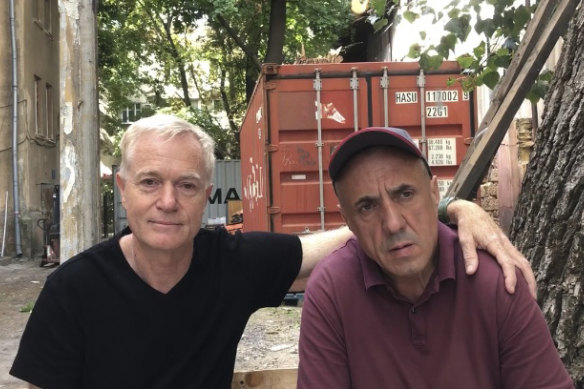
Maurice O’Connell and and his friend Misha in Odesa.
I first met Misha and his eight-year-old son when they turned up seeking help from my fellow volunteer aid workers in Odesa. He was barely able to speak. Gradually, we learned what had happened and how Russian soldiers had also murdered an entire neighbouring family. All Misha could say was: “I just don’t understand how they could hate us Ukrainians so much.”
Tragically, Misha’s story is all too common. During my six months in Odesa in the past year, I saw and spoke to countless Ukrainians who had been displaced, many with friends and family killed, raped, injured, tortured or kidnapped by the Russians. It is a brutality that is routine and systematic.
Coming from Adelaide, this was not something I could have imagined if I had not gone to Ukraine myself. When I arrived in Odesa in May, I was vehemently opposed to what I saw as “Putin’s War”. I had also assumed the many ties between ordinary Ukrainians and Russians, especially of kinship and friendship, would spare the country from the atrocities Russia has committed in Syria and Chechnya.
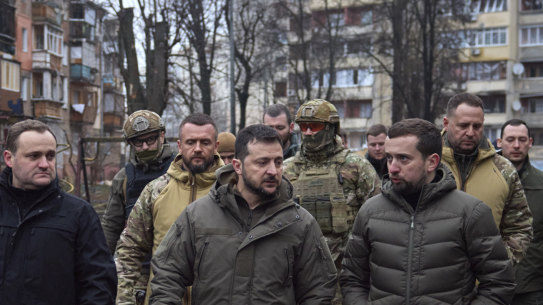
As we all know, this has not been the case and Ukraine and the West are right to investigate Russia for war crimes and to strive to bring the perpetrators to justice, no matter how long it will take and how difficult it will be.
Every morning, my fellow aid workers and I saw people arriving for help. First they came primarily from Kherson and Mykolaiv, then from the Mariupol region. A steady stream of refugees from the Luhansk and Donetsk regions remains uninterrupted.
Many have only the clothes on their backs and a small bag or suitcase with all that is left of their lives. Their plight and that of all Ukrainians will only get worse in the next few months as the Russian military seeks to destroy all power and water supplies as the harsh winter weather sets in. The temperature in Kyiv in January averages between minus 2 and minus 6.3 degrees.
One day, I was returning from Romania after having picked up donated supplies, and a few cartons of Coca-Cola, beer and wine for a well-deserved party for my colleagues. However, when I got back, the mood was grim following an operation to ferry refugees fleeing the occupied areas.
Two people had been killed: a woman passenger and the friend of a colleague who had a wife and four children. For two days, his body lay on the road where he had been shot. It was too dangerous to attempt to retrieve it. Several others were wounded, including one seriously. The colleague who saw his friend shot is now a registered witness to a war crimes investigation.
I have also seen hospitals and schools attacked. In one case, Russia claimed a school at Dachne on the outskirts of Odesa had been targeted because it housed Ukrainian and international fighters as well as military equipment. My colleagues and I visited the school a few hours after the attack and saw no evidence to back those claims. From what I could see, it was functioning solely as a school. Its principal was shaken, in disbelief.
It is a cliche but it is also apt and true: war brings out the best and worst in people. During my time in Ukraine, I saw so many examples of nobility, generosity and selflessness rising above tragedy and terror.
When we issued a call for help to renovate a building the authorities had given us, tradesmen from all over Odesa volunteered time and hard-to-get materials. We had it operational within a week and from it can deliver aid to 200 people daily, including those near the frontlines.
Misha and many other displaced people are now volunteers who come most days to help assemble food parcels. He has found some solace, understanding and companionship among the other volunteers. Besides the physical injuries, for Misha and many others, there are the mental wounds, of which we cannot even start to comprehend.
I returned to Adelaide in early November. I am proud of the aid Australians and their government have given to Ukraine. It’s important that this continues and we show Ukraine it is not alone. The next few months will be very tough.
Maurice O’Connell is a volunteer aid worker. He will return to Ukraine in early 2023.
“All Misha could say was: “I just don’t understand how they could hate us Ukrainians so much.”
Good question. The better educated Russians always had a patronizing, colonial “we must do something about the fuzzy-wuzzies”-type attitude. Before the rise of putlerism, the most prized restaurants for the educated elite in Moscow were Georgian and Ukrainian. Georgian and Ukrainian wines and other produce were much sought after.
Then putler invaded Georgia, shut down the Georgian restaurants and banned Georgian wine. Did the same to Ukraine in 2014. At that point the lofty colonialist attitude descended into hatred. Puker and his malignant kremkrapper broadcasters whipped up that hatred into something insane. People like Solovyov, Scabby, Simonyan and Dugin put out foam-flecked rants of a toxic hatred never seen in history.
Putler’s orcs are required to read his version of Mein Kampf before crossing the border to murder Ukrainians.
That’s why Ukraine simply has no option other than slaughtering invaders in Stalin-type industrial numbers. No choice at all.
Allies : FFS send the defenders much more destructive weapons in ever-increasing amounts. Including longe range ballistic missiles.
“Coming from Adelaide, this was not something I could have imagined if I had not gone to Ukraine myself. When I arrived in Odesa in May, I was vehemently opposed to what I saw as “Putin’s War”. I had also assumed the many ties between ordinary Ukrainians and Russians, especially of kinship and friendship, would spare the country from the atrocities Russia has committed in Syria and Chechnya.”
Ruskies are putrid hate-mongers. It’s a part of their foul, festering genes. I know one couple in Simferopol, who are pro-Putler. Even after all the horrid atrocities that his gang of criminal stormtroopers has committed. And, despite the fact that the husband’s sister lives in Kharkiv. Enough said…
I’ve experienced some people like that too and it seems like they feel they have to ever increase the size of their already largest country in the world. If they’re not trying to conquer something they’re not happy with leadership. As if the government’s only purpose is to conquer more territory. Forget about the economy, roads, education or healthcare, they’re just interested in war. Constant war as long as it doesn’t affect them.
Even more reason to totally destroy their war-fighting capabilities.