


DW Phillips
Nov 27, 2025
War is the crucible the proves true love.
The Kyiv Post has been kind to publish today my article on life, love and loss during the war for Thanksgiving Day. Within the span of 30 days, Iryna Ivanova married the love of her life, lost him as he defended Ukraine’s skies in his F-16, and discovered she was carrying his child.
It’s a deeply personal look into the story of my friends Pasha Ivanov – Hero of Ukraine with Gold Star – and the journey of grief and new hope experienced by his wife Iryna. The article follows a journey from my home on Thanksgiving Day 2023 with Pasha, to this Thanksgiving Day.
I think you will find it different – fresh and hopeful.

My Pilot, His Burning Piano, My Child – a Timeless Love Story
Within the span of 30 days, Iryna Ivanova married the love of her life, lost him as he defended Ukraine’s skies in his F-16, and discovered she was carrying his child.
by DW Phillips | Nov. 27, 2025, 11:31 am

Captain Pavlo Ivanov, Ukrainian Airforce. (Photo: Kostiantyn Liberov)
- Before they became a couple
- Iryna
- A love story to remember
- Will you marry me?
- Marrying a fighter pilot
- A team effort
- What it means to marry an F-16 pilot
- That day
- Mourning and grief
- War widows
- The pilot
- Hero of Ukraine
- Burning the piano
- A national grief
- New life
- A calendar of sorrow
- President Zelensky
- Other widows
- A lifetime of love
War is a crucible that purifies true love. Those who meet and marry during war often experience a special clarity. The trivial dissolves. No time for secondary matters. Passion and purpose are amplified.
The ever present specter of death makes moments more precious. There is urgency. What if tomorrow never comes?
And the very transience of wartime reveals a deeper reason why we fight – not only for country, family, and comrades, but for the hope of what life and love can bring.
nullnull
Over the span of a year, Iryna Ivanova lived a lifetime of love with her Ukrainian F-16 flyboy, Captain Pavlo Ivanov.
She never imagined, watching him as a 17-year-old at his Air Force cadet induction ceremony, that years later they would be man and wife.
Introduced to the young pilot by her brother, Iryna and Pavlo knew of each other from a distance for years. But in the spring of 2024, they developed a friendship and soon became inseparable.
Early on their conversations became deep. After just months of talking, they knew they could trust each other with many secrets.

Pavlo and Iryna Ivanov on their wedding day. (Photo: Antonina Mazokha)
One day Pavlo looked at Iryna and said:
“I have been looking for you my whole life, and you were always there.”
What followed was a whirlwind romance.
It was true love.
Then on March 29, 2025, they were wed in a beautiful ceremony in Kyiv.
It was a perfect day. A perfect moment. There was no fear and no war. Just happiness and beauty. Just Iryna and Pavlo.
Exactly 14 days later, Pavlo was killed in action over Sumy.
On that terrible morning of April 12, 2025, Pavlo leaned over to kiss Iryna’s belly before leaving for work. It was his ritual – almost a prayer – that God would send them a child, and specifically, a little girl.
But Pavlo never came home to Iryna.
The same weekend that Putin launched his notorious ballistic missile strike at civilians leaving church in the town square of Sumy, Pavlo’s mission defending the innocent came to an end.
He never learned that his departing prayer had been answered, because on April 29, one month to the date of their wedding, and two weeks after losing her husband, a sonogram confirmed that Iryna was carrying his child.
Before they became a couple
I met Pavlo in the summer of 2023.
My home became something of a refuge and gathering place for about a dozen Ukrainian flyboys.
I’d order Ukrainian food from a local shop so the men could enjoy the familiar tastes of salo [Ukrainian lard], black bread, and borscht.
On weeknights, we smoked cigars, toasted with tequila to the hope of a free world, sang “Chervona Kalyna” and the anthems of Ukrainian freedom while one of the pilots strummed a guitar.
They were a remarkable band of brothers. Some of the best and brightest of this generation of Ukrainian warriors. Men of crystal-clear purpose and potent skill.
Pavlo became a fixture in my home. Kind-hearted, possessing a quiet confidence. He was thoughtful, with a touch of poetry in his soul. Like all the pilots, he ached to get back to his bird and defend his skies.
I gave them a traditional American Thanksgiving experience. We feasted and kept a family tradition of throwing spears at targets. On New Year’s Eve, we celebrated with stories of love and war. Some of the pilots came with their wives and young children. The little ones climbed on their fathers and played with the dog.
That night was especially memorable. Among our guests was a decorated 97-year-old retired Lieutenant Colonel from the Air Force Reserve, a veteran and a decorated navigator who witnessed some of the great battles of the Pacific in World War II and flew missions in the Korean War.
The Ukrainian pilots gathered around him, rapt with attention, as he shared his stories. It was inspiring to witness: aviators who together spanned nearly a century of military history, the younger generation honoring the elder.
Next to the Lieutenant Colonel sat Pavlo, hanging on every word. To his right was Maksym Ustymenko – my dear friend, and himself a Lieutenant Colonel. At just 29, he was a steady presence, full of charm and focus, a senior pilot respected by the others.
Both Pavlo and “Max” would perish within three months of each other. Both died in their F-16s defending the innocent from the Russians. Both were posthumously awarded Ukraine’s highest honor: Hero of Ukraine – Order of the Gold Star.
I am typing this story on the table where I sat with both men, where I learned of their deaths, and where for the last six months over text and video Iryna and I have shared an uncommon conversation about life, love, widowhood, and the grief of a war bride.
Iryna
At 24 years of age, standing 168 cm (5 feet 6 inches), with long dark straight hair in the Ukrainian style, Iryna is the embodiment of the many painful and beautiful contradictions of this terrible war – purpose, faith, resolve, heartache, hope – all in a single expression.
There are themes to our conversations – what it meant to be loved by a man like Pavlo; the moment by moment reality of grief; finding beauty in ashes, the mercies of God, and the ongoing mission of the wife of a Hero of Ukraine.
I have questions for her, but she has them for me.
“He talked about you often. But can you tell me what was he like in your home?” Iryna asks.
When you lose the love of your life, the smallest details of the world you once shared feels like treasure. Every conversation remembered, letter written or photo taken becomes a sacred archive.
“Not all single pilots want to marry,” I told Iryna. “They understand the risks. But Pavlo made it clear – he wanted a family.”
One night, we cornered him for clues on his romantic aspirations:
“I’ve got to find the right girl. Yeah, I just got to find the right girl,” he told us in his understated manner.
Find her he did.
A love story to remember
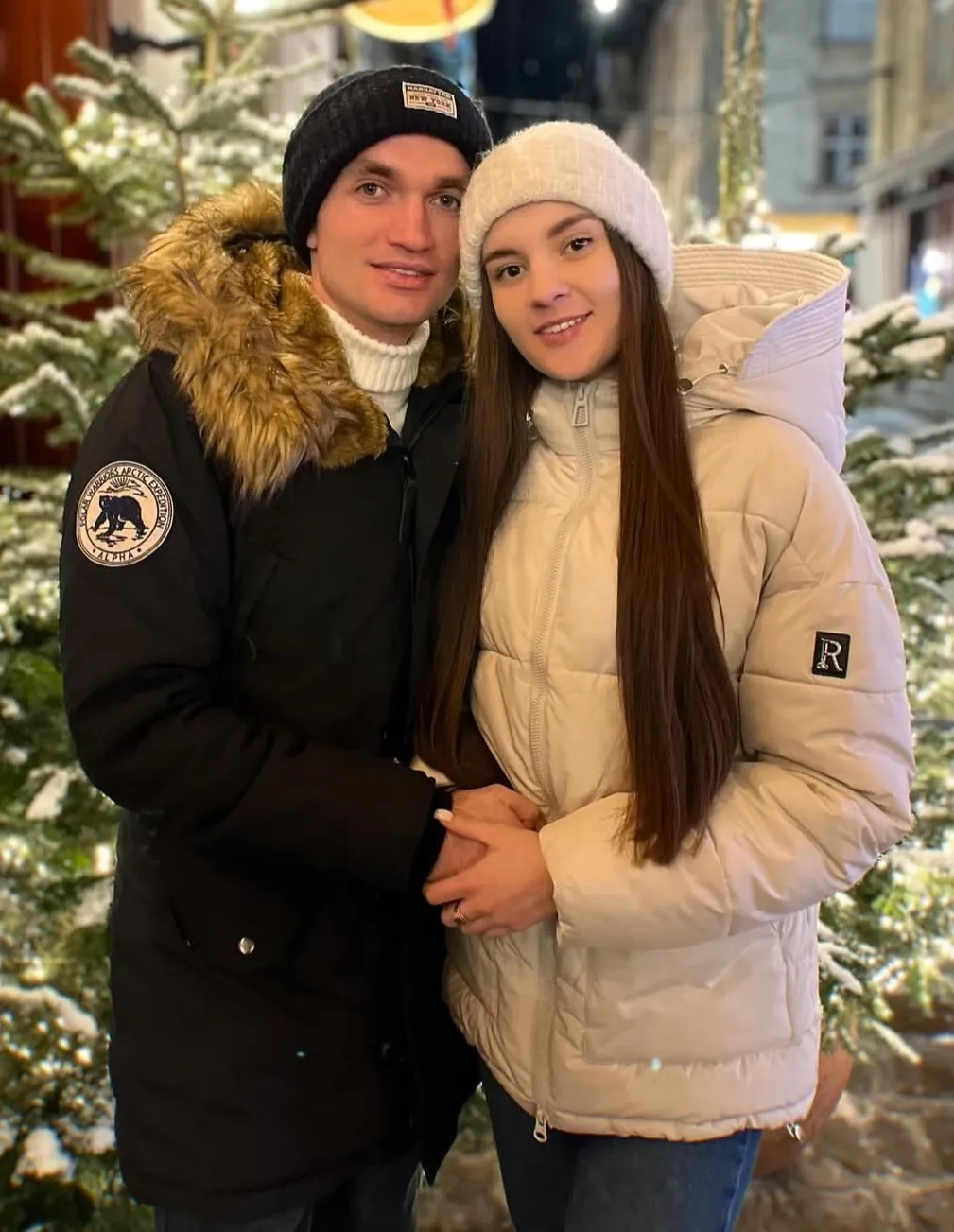

Pavlo and Iryna on Christmas, December, 2024. (Photo courtesy Iryna Ivanov)
By spring of 2024, a new friendship between Iryna and Pavlo was blooming into something deeper.
“That summer revealed some of the happiest days of my life. We used to call each other sonechko,” Iryna tells me.
“It means sunshine.” She smiles as she explains. “It was very very cute because he loved the sky. That was our special word — sonechko.”
One Sunday morning, as they were getting ready for a walk in the park, Pavlo first told her: “I feel you are my family.”
“Everything between us was natural and mutual,” she explained.
“We would take long walks through the city, taking time to watch the older couples, picturing ourselves the same way.”
He said to her, “We will be like that too, together all our lives.”
“We dreamed of a future life together – and that once the kids were grown, we’d always stay just as romantic.”
“I will go before you Sonechko,” he told Iryna.
“But if we don’t leave this world on the same day, then maybe just two or three days apart. We won’t have to miss each other for long,” Iryna replied.
“What did you love about him,” I ask Iryna.
Without a pause, she replies: “The way he loved me. It was perfect. I felt as if no woman had ever been loved by a man as he loved me.”
“But there were so many reasons,” she continues.
“He loved his country. His decision to serve Ukraine at just 17 showed an incredible sense of devotion to Ukraine. I always knew he had a great inner strength and a true calling. I loved him for this and I would follow this man anywhere.”

Pavlo and Iryna on their wedding day. (Photo: Antonina Mazokha)
Will you marry me?
It was in the ancient snow-capped mountains of the Carpathians that Pavlo asked Iryna to be his bride.
“Everything about our love felt like a movie to us – the most beautiful kind, where the main characters are completely, wholeheartedly in love.”
I already had the feeling that this would be the proposal – in the mountains, where everything felt magical. I’ve always loved the mountains. Pavlo knew that.”
Iryna described to me the scene:
While we were staying in the mountains, Pavlo could hardly contain his emotions. He kept taking my hand, gently brushing the finger where the ring would go. I teased him, “Are you worried it won’t fit?” and he laughed, “Yes, I think it might be a little too big.”
“He wanted to propose at Lake Synevyr, but the lake was frozen, so we stopped by a mountain river to take some photos instead. That’s when he pulled out a bouquet of white roses – my favorite color of roses. Then he knelt down and said the most heartfelt words – words I had heard from him many times before: how deeply he loved me, how I was the one he had been searching for all his life, and how he wanted to spend the rest of his life with me, for me to be his wife.”
Pavlo and Iryna were married in March in a beautiful ceremony in Kyiv.
“I don’t know who waited for this day more – me or Pavlo,” she tells me.
“We invited only a few: first, because of the war not everyone could come, and second, because we wanted only close friends who shared our joy.”
“The day before the wedding, we went on a date, and I said to Pavlo, ‘Can you imagine this is our last date as just a couple, before we become husband and wife?”
He laughed and said, “Finally, you’ll be officially my wife.”
“I wonder if I had ever been so happy as I was at that moment,” Iryna remembers.
“It’s so hard to remember this now, because in our dreams it was supposed to be like this all the way to our old age – together, side by side.”
Marrying a fighter pilot
“Did you understand the risk you were taking marrying a fighter pilot?” I ask Iryna.
She doesn’t blink: “The real risk wasn’t the war, but letting fear rob me of the chance for the greatest happiness of my life.”
“Marrying Pavlo was the easiest and best decision of my life. But I also knew what that meant: He belonged to me, but also to Ukraine.”
“Did you continue to feel that way after the wedding?” I ask.
“Of course. It was never a competition, because everything always felt just right. Pasha showed me that he loved me more than life itself, but I also knew he breathed the sky. And I loved that. I breathed it through him.”
“He would rush into every mission, every battle, no matter the risk. He once told me: ‘Children should grow up and be born under a peaceful sky.’”
“We often talked about peace – about how everyone longs for this war to end. And he once said something I will never forget: ‘We must do everything we can to make sure this war never reaches our children – so that Ukraine will finally be free, strong, and independent.’”
A team effort
Ukraine’s fighter pilots occupy a sacred space in the country’s war for survival – both in their strategic role and in the hearts of the people.
Unlike infantry units, which defend sectors of the battlefield, Ukraine’s F-16 pilots are tasked with defending the geography of the entire nation. One hour they might fly over Lviv, the next over Kyiv, then Odesa, then provide support to frontline troops. Their area of responsibility is a nation under siege. The mental and physical demands are staggering. Every mission carries with it the real possibility of not returning – whether from malfunction, missile strike, or the sheer danger of their profession.
The pilots will tell you that they are not a one man show. They fly successfully because they have deeply interwoven, well-tuned teams, skilled ground crews, and a command and control structure which has been finessed and trained to battle excellence.
But in the end, it is the pilot who climbs into the cockpit. It is the pilot who must take off – often with seconds’ notice – and carry the mission through to its final moments.
What it means to marry an F-16 pilot
To marry a Ukrainian fighter pilot, is to enter the world of an elite brotherhood – a society of aerial warriors whose lives are defined by extreme risk and whose work requires a heightened level of anonymity.
In the course of the war, individual pilots may engage in hundreds of missions that flirt with death. They must be emotionally and mentally strong as they guide $25 million machines through the sky at Mach speed with a surgeon’s calm and a soldier’s steel. Each pilot must possess extraordinary razor-sharp instincts, and the capacity for split-second decision-making. The entire country entrusts them with its survival.
“Happiness at home reinforces strength in the skies,” Iryna says.
“It was easy for me because Pavlo was such a happy man.”
Pilots like Pavlo are on constant standby – day or night, ready to launch within minutes. Their operations are shrouded in secrecy: from the secure hangars where their jets are housed to the routes they fly, to the families they return home to.
On those rare occasions where stories of their successes reach the public, they can only be known by their call signs – radio nicknames used for anonymity, speed, and clarity on the air.
Call signs are typical picked by peers, rather than the pilots themselves.
“They called my Pavlo ‘Scratch.’”
That silence extends to their loved ones.
Pilot families also must remain in the shadows. Wives like Iryna carry the weight of both love and secrecy. They cannot share details. They don’t know everything. What they do know is that each goodbye might be the last. So they hold tightly to hope, to faith, and to the quiet prayer that the next kiss goodbye won’t carry the weight of forever.
Marrying a pilot means that even home life is a potential target. Russia wants to destroy not just the aircraft, but the lives that support them – their spouses, their children.
“The enemy actually sent Russian Special Services to burn my home down, Iryna told me. “Thankfully we came out fine. The spies were apprehended.”
“War brides know what we are signing up for,” Iryna says.
“We go into marriage understanding that safety requires discretion.”
“We also understand our husband might make the ultimate sacrifice.”
You understood intellectually, but did you really comprehend?” I ask Iryna.
“Of course not. That’s just impossible.”
But she adds: “Pavlo did everything he could to prepare me for being the wife of a pilot, even the possibility of losing him, but nothing you can say or do prepares you for that.”
“This year, in February another pilot died – he had a five-month-old son. Pasha, in his gentle way, said that he, too, would want to leave something behind. He said it delicately, knowing how deeply it tore me apart inside.”
“Even though I understood that this is war and that these things happen, I never – not even for a second – wanted to imagine that something like that could happen to my Pavlo.”
I ask Iryna: “What about his missions? Did he tell you about them?”
“Pavlo honored the code. He never spoke of confidential matters.” she continued. “But we did speak of his work He loved people. Every piece of news about civilians being killed truly hurt him.”
“My husband inspired me every day. He would rush into every mission, every battle, no matter the risk. He once told me, ‘Children should grow up under a peaceful sky.’”
Around my table in America, Pavlo and I used to talk about life after victory. I ask Iryna if she had similar conversations.
“We often talked about peace,” Iryna reflected to me. “He once said something I will never forget:
“We must do everything we can to make sure this war never reaches our children – so that Ukraine will finally be free, strong, and independent.”
That day
April 12, 2025 was the two week anniversary of Pavlo and Iryna’s wedding. They had scheduled a special date for that night. In a few days they were going to head to Greece for a short honeymoon by the ocean.
The 12th was supposed to be a happy day. A celebration.
Time has not made it easier to remember the details, but somehow Iryna musters the strength:
“After Pavlo left for work, I fell back to sleep but had a terrible nightmare.”
Next she describes to me in vivid detail her dream – she was looking down at her wedding ring covered in blood.
“I woke at 11:23 in panic and immediately sent him a message saying that I was waiting for him to return from his mission.”
There would be no reply.
She paced in front of the window hoping to catch a glimpse of his car. Nothing.
“In my mind I kept thinking he would come. Everything would be as usual. He would come.”
It would be almost two more hours before she learned the truth.
At 1:30 a group of pilots in uniform arrived at the home of Iryna and Pavlo.
“I saw so many soldiers, I was in shock – I already realized that something had happened,” Iryna remembers.
“When we were going up in the elevator to my home and everyone was silent, those two minutes felt like days, because I was running through so many possibilities in my mind and opening my messages to Pavlo which had no replies.”
From that moment on, the world turned upside down for Iryna.
First comes the fear. Your mind races for options. Capture. Injury. Anything but the permanence of death. Then comes the news, which transports you to a state of unreality and shock. Surely, this cannot be true. Surely, it is a nightmare – a terrible dream. The mind and the body become manic. You cannot think or rest. Even crying eludes you. Your insides are screaming, but no sounds are forthcoming. Still, you rise after your first sleepless night alone to a world which you always knew was possible, but for which you are completely unprepared.
“In the dream, my wedding ring was covered in blood, but in reality, it was his ring that was bloodied – which I found out on Monday when I collected his ring from the morgue. It looked exactly like in the dream.”
It was later confirmed that Pavlo was killed at 11:18 a.m., about the same time Iryna had her dream.
Mourning and grief
Losing your partner and best friend is a unique kind of pain.
“It doesn’t fade with time,” she tells me.
“It doesn’t go away when you try to return to life.”
“It’s a longing for a life that no longer exists.”
“Every day, you learn to live in a world that has become empty and foreign. You talk, smile, maybe even make plans, but inside – there is a wild loneliness.”
“For the longest time I had no tears. My mind refused to accept it, but my whole body ached.”
“The passage of time only gives the sense that you are moving further and further away from the day you last saw them, touched them, heard their voice.”
“Now, only you remain, while half of you is gone… It is an amputation. An amputation without anesthesia.”
She hesitates with a moment of uncertainty: “My thoughts are probably not very clear; not all feelings can be explained with words.”
Then she continues: “It is natural that life goes on for everyone else, but for me it stopped on April 12.”
“I find myself grasping to preserve every possible reminder of my husband. Every note and artifact of his life. His scent on a pillow or unwashed shirt.”
“If only it were possible to preserve a scent,” she muses to me.
War widows
Every war widow has a story. Each are unique. Painful.
The war widows of Ukraine carry an extraordinary burden. Somehow they must choose to live another day. They must face the future alone with a hole in their heart. They must figure out how to navigate the expectations of the world.
“But when every day in Ukraine young families lose a father, a husband – it’s horrible, and it weighs so heavily on you. There is simply too much pain.”
“There are thousands Ukrainian war widows like me,” Iryna says. “Each of us feels that our loss is the greatest. It is natural,” Iryna reflects thoughtfully.
“Each of us bares pain and sorrow in our own way. I am not special, but my husband was.”

The pilot
“Tell me about Pavlo as a pilot?” I ask Iryna.
I imagine that every Ukrainian pilot’s wife is proud of her husband, but I observe something special click in Iryna. There is steel in her eyes. The grieving widow straightens. The patriot surfaces. The proud wife speaks.
“He was fearless.”
She tells me about Pasha’s life as a combat pilot – a gifted aviator who flew low and close along the front line, threading narrow margins with lethal precision. He struck vital enemy positions and shielded his comrades and civilians.
Many missions?
“More than 130 combat missions on an assault aircraft,” she explains. “He quickly excelled, taking on the most demanding operations, and carried that same fearlessness into the skies when he later flew the F-16,”
“Were you excited for him when he defended Ukraine in the F-16?”
“Of course. Pavlo was the first Ukrainian attack pilot to retrain and fly the F-16,” Iryina beams. “It was a historic achievement.”
Hero of Ukraine
The day that Pasha was downed by a Russian missile he engaged in an air battle, defending the borders and holding back the enemy advance towards Sumy.
There had been no opportunity to eject.
Pasha’s body was found on the wing of his F-16 in a field.
Shortly after his death, the Russians managed to temporarily break through the defensive line. His death was not only Iryna’s loss – the whole of Ukraine lost him.
Within hours of Pavlo’s death President Zelensky signed papers designating him Hero of Ukraine with Gold Star. It was the fastest recognition of a pilot of Ukraine’s highest award in the history of the nation. He was also posthumously promoted to the rank of major.
Burning the piano
Today, the pilots of Ukraine have more combat experience than any air force in the world. They also have a deep sense of their identity and role in aviation history. You see it in their call signs, symbolism, sense of history and identity.
A few days after Pavlo made the ultimate sacrifice, his fellow pilots gathered to honor him with a sacred ritual. When a Ukrainian pilot dies in combat, his comrades gather on the tarmac and burn a piano to honor the departure of his soul into the afterlife. It’s a tradition with origins in the British flyboys of WWII who defended their island nation against the Nazi Luftwaffe.
“The burning piano is a reminder that these are poet warriors. My Pavlo was one of them,” Iryna shares with a quiet humility and pride.
The piano usually bears the call sign and sometimes the number of the aircraft that was lost. They play a farewell song on it, and then it’s set on fire. All the pilots stand in silence until it burns down completely. When the flames die out, the aircraft fly over.
A national grief
When a pilot goes down it’s a loss felt in every heart that looks to these knights of the sky as guardians to protect their children from Putin’s deadly projectiles intentionally aimed at eliminating Ukraine’s families as they sleep.
Being the widow of a Hero of Ukraine means that grief is never a private affair.
“Pavlo belongs to me, but I know that his legacy also belongs to Ukraine,” Iryna tells me. “It is a comfort to know how deeply his countrymen valued him. “
“In the midst of this loneliness, new friends emerged. Countrymen I never knew who found me. To send me notes of encouragement. To weep with me. I am so proud of my fellow Ukrainians. If only the world knew the beauty in their hearts.”
She shows me a card she received from a stranger. It reads:
“Boundless gratitude and respect to you for the resilience and moral strength you show every day. Many thanks for the support that gives us wings!”
“I always felt so safe with Pavlo. He was a born protector,” she tells me. “He made others feel protected also.”
“Since Pavlo’s death I have also received special words of gratitude from soldiers on the front line,” Iryna tells me.
“It meant so much to them to have cover from the sky – they knew that Pavlo and the other pilots would always come, no matter how difficult the mission was.”
“It is something I saw every day – Pavlo wanted to give them that feeling of safety – to let them know that no matter what, someone in the sky was always guarding them.”
New life
Within four weeks of Pavlo’s death, there were signs.
Soon her suspicions were confirmed. Iryna was carrying their child.
A month later she sends me a picture – a sonogram.
“All the pilots were expecting a boy, and I thought it would be a boy too. But it’s a girl – definitely a girl. They measured all the organs, and everything is fine. Pavlo’s dream has come true.”
Ukraine is in the midst of a birth dearth. Because of this war, Ukraine now has one of the highest mortality rates and the lowest birth rates in the world. There is a disturbing rise of fatherless and orphaned children. Some couples feel cautious about bringing new life into a war torn world.
But children represent the future of Ukrainian culture and the nation-state. Putin knows this, which is why the missiles Pavlo attempted to eliminated in his F16 were often targeted on civilians – schools, nurseries, children’s hospitals and homes. It’s why Russia has become the largest state-sponsored child abduction organization in the world. By stealing Ukraine’s children the Kremlin hopes to deny her a future.
Couple’s like Iryna and Pavlo were motivated to seek new life.
“Both Pasha and I loved children. But before we met each other, neither of us had really thought about starting a family.”
“With Pasha, everything felt different. Early in our relationship, he once told me that he could already imagine how beautiful I’d look being pregnant, carrying our baby under my heart.
After he proposed, we decided to start planning for our little happiness. Pavlo would say, “Children are born quickly from great love.”
“We never even discussed a specific number of kids – we just knew that our love was big enough for many. Even before the wedding, we would walk around shopping malls looking at baby clothes, talking about how soon we’d be picking things out for our own child. We were so, so happy – two people who had finally found what they had been searching for their whole lives.
Pavlo wanted a girl first, and I hoped for a boy. We even talked about the birth itself – he said he wanted to be there with me because it would be such an important day for him too. But most of all, he said he dreamed of the moment when the baby would be placed in his arms after birth, so she or he could start bonding with him. He was really looking forward to that.
And every time I listened to Pavlo, I felt how beautiful our family already was – and how deeply God must love me to have heard my prayers and brought him into my life.
“Our child growing under my heart is what gives me breath. I believe God has preserved me in this way. He heard our prayers and made our dream of having a child come true.”
I ask her about the challenges of carrying a baby to term alone. But she never speaks of practical challenges. Those things seem to matter little to Iryna. Our conversations always return to her love affair with Pavlo.
“It feels so strange to experience joy when I feel the baby move, and at the same time, a wild sadness for my husband… Every time I think about our child, I imagine how happy we would be together, waiting for her to be born.”
“My husband’s motto was: ‘Light always defeats darkness. Together to victory.’
“He signed his cards that would be given to friends, children and volunteers with this motto. They often sign things – little calendars or notebooks. Some future pilots have already sent me things he gave to them with his signature.”
“I want to print more of these cards with his
picture and motto – to give them to children. I want them to be reminded of the price of freedom. I don’t want them to doubt that we will win in the end.”
A calendar of sorrow
“It is natural that life goes on for others. But for me, it stopped.”
Grief has no schedule. It arrives as an unwelcome guests and lingers indefinitely.
For seven months I listened as the process unfolded for Iryna.
April: “Today marks exactly one week. I miss him unbearably. It’s like I’m dying without him. I worry he will drift farther and farther away.”
May: “I feel like he’s still here. But his scent is fading from the shirts, and his physical presence is slipping away – it hurts.”
June: “In real life I grieve quietly, I am broken and weeping. I search for Pavlo in all the places we used to go. And he’s not there.”
July: “All the pilots were expecting a boy, and I thought it would be a boy too. But it’s a girl – definitely a girl. They measured all the organs, and everything is fine. Pasha’s dream has come true.”
August: “The night in Kyiv was terrible. Constant bombs. In my dreams I was looking everywhere for him. Shouting for Pavlo to come to me.
September: “I read through our messages again today. On the next page is his message saying, ‘I love you more with each passing day.’”
October: “Sometimes Pasha appears in my dreams as if nothing happened. In one dream I touched the places where he had wounds, saying, ‘You survived, you’re alive,’ and I saw him and touched him as if nothing had happened.”
November: “It’s been seven months since we kissed goodbye. It feels like forever. It feels like a second.”

Iryna presents the president with the unit patch of her husband. (Screenshot)
President Zelensky
The closest Ukrainian equivalent to the American Medal of Honor is Hero of Ukraine. It is the highest national title that can be conferred upon a citizen of Ukraine. It is not a medal in itself but an honorary title accompanied by one of two state insignia – the Order of the Gold Star (for heroism) or the Order of the State (for outstanding labor or service).
Just over 900 have received Hero of Ukraine with Order of the Gold Star. It is Awarded for personal heroic acts in defense of Ukraine’s sovereignty, independence, and territorial integrity, or for other deeds involving exceptional courage and self-sacrifice.
On Aug. 3, 2025, Ukrainian Airfare Day, President Zelensky conferred Ukraine’s highest honor on Pavlo in a special ceremony with Iryna – Hero of Ukraine order of the Gold Star.
“Each name spoken today is a story of feats… There would be no Ukraine without such people, without such heroism.”
I was overcome with such emotion. President Zelensky looked at me with great compassion. He could see that I was carrying Pavlo’s child.”
When the President began with the words “I thank you,” tears welled up in Iryna’s eyes.
“On behalf of the people of Ukraine – thank you for your courage and sacrifice. Eternal honor to our heroes.”
She looked at the medal, then at her belly. The baby moved, as if listening.
Iryna took Pavlo’s patch, handed it to President Zelensky. He began to examine it.
Then she gathered her courage to make a statement to him she had rehearsed.
Their eyes locked.
“President Zelensky, my husband Pavlo respected you greatly and considered it one of the great honors of his life to serve under your command in the fight for Ukraine’s freedom.”
“Looking back on that moment, how do you feel today,” I ask Iryna.
“Grateful,” she said. “I feel really grateful – grateful to my country. And to the Armed Forces of Ukraine for their protection.”
“I felt such pride for Pavlo. He protected all of us – he gave his life, his dreams, and his plans. Everything he had ended so that we could live.”
“I will raise our child knowing that Pavlo was a hero – because he lived like one in every flight, in his deeds for us, and in his sacrifice.”
“That’s who he was. That’s the man I married.”

On Aug. 3, 2025, Iryna Ivanova met President Zelensky at state awards on the occasion of Ukrainian Airforce Day, to receive the Gold Star posthumously awarded to her husband Pavlo Ivanov.
Other widows
There are more than 40 million Ukrainians – and each has a friend or relative who has become a casualty of this war. Grief is a national reality.
“I started talking to other war widows. They understood me and gave me so much support, especially within the community of pilots.”
“Each of us processes grief in our own way. But there is a common denominator: we know that our loss has become the gain of every child given the chance for a full life because of our husbands’ sacrifice.”

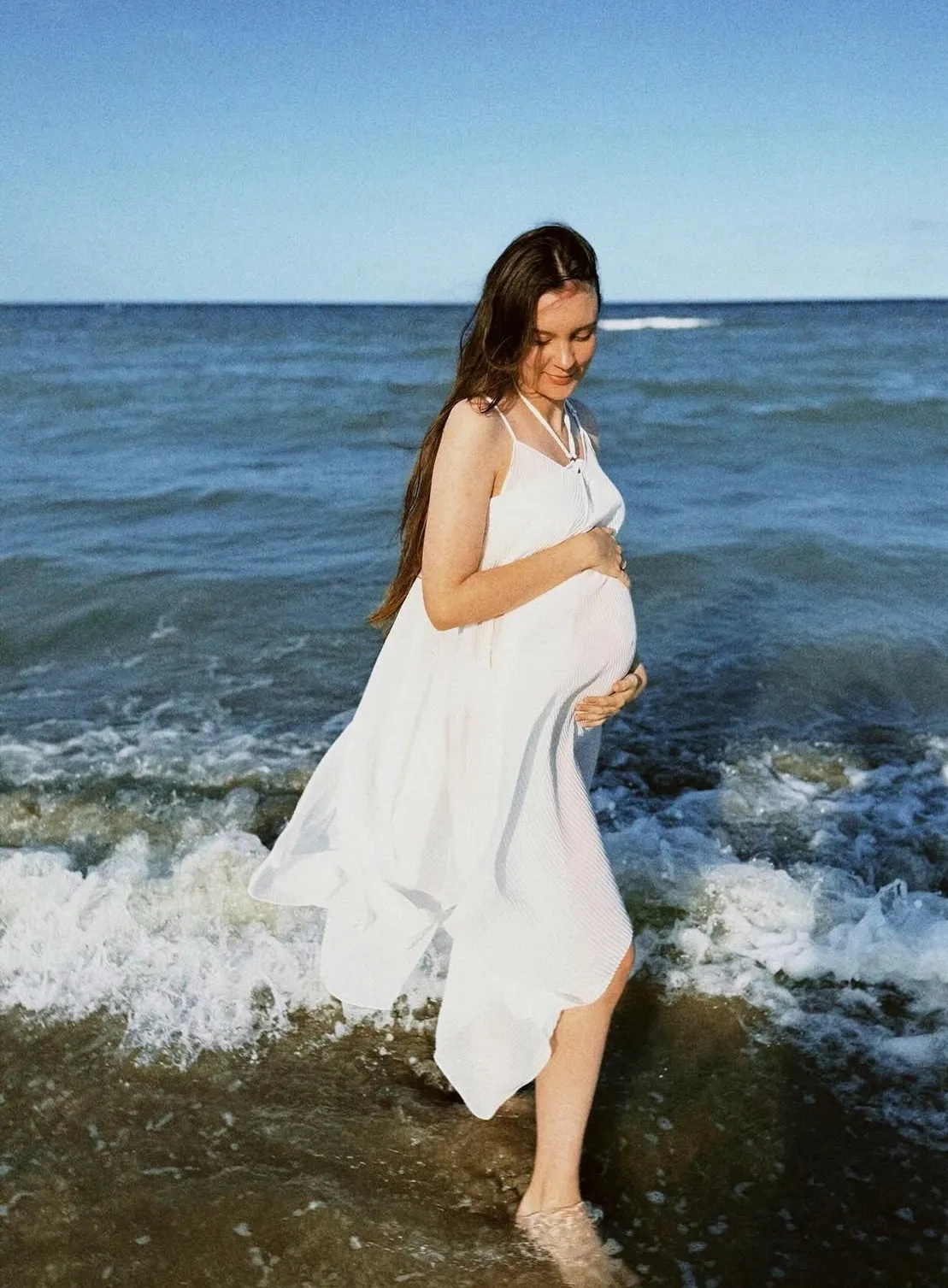
Iryna, seven months into her pregnancy with Pavlo’s daughter. (Photo courtesy Iryna Ivanov)
A lifetime of love
Some people experience love over a lifetime. A precious few experience a lifetime’s worth of love in a single season. Iryna and Pavlo shared the latter.
Their story arcs from dazzling beauty, to crushing tragedy, to the quiet miracle of new life.
“Pasha believed that if everyone found their person, they wouldn’t measure love by time – but by the depth of feeling. He was right.”
Seven months into her pregnancy, Iryna carries the serene glow of motherhood.
Pavlo’s birthday was Dec. 27. She expects their daughter to enter the world around that time.
“There is an ancient church in Lviv that Pavlo loved so much. We listened to the choir sing “Shchedryk – Carol of the Bells” – there on Christmas. I go there sometimes to pray. That is where our daughter will be baptized.”
“Our child growing beneath my heart is what gives me breath,” she tells me.“I know she is God’s gift. He heard our prayers and made our dream come true.”
She pauses, her eyes fixed on the window. “Even so, it feels so strange – to experience joy when I feel the baby move, while also feeling such wild sadness.”
“Your daughter will be born into a world at war,” I say quietly. “What do you think Pavlo would have said about her future?”
Without hesitation, she answers: “Someday the Russians will be defeated. The bombs will stop falling. A new Ukraine will rise. My husband was clear. He wanted a child to carry on his legacy when he was no longer guarding the skies. He believed that if we had a child, she would be part of the generation that rebuilds Ukraine. She will be part of that future,” Iryna tells me. “She will grow up knowing her father died for her – so that the children of Ukraine could live.”
What’s next for the bride of the fallen Hero of Ukraine?
“It is hard to see too far ahead when the sting of grief is still so present,” she admits. “But even now, I know my life will be devoted to continuing Pavlo’s work. I can’t fly a jet – but I can tell the next generation about a great man who did. I can remind them that to live well, you must have something worth dying for. That’s how Pavlo lived. It’s why he died. It’s why he was worthy of being called a Hero of Ukraine. And there are many, many others who may not have the official title – but they too are the true heroes of Ukraine.”
“Do you ever doubt?” I ask.
“It takes a lot of faith to trust God and accept His will. I don’t ask questions like ‘Why?’ or ‘Why me?’ or ‘Why him?’ Each of us has a mission on this earth. Pavlo had a mission. He completed it. He defended Ukraine. He saved the lives of thousands of innocents. ‘Greater love hath no man than this, that a man lay down his life for his friends.’ (John 15:13)”
Iryna looks up directly, with a confidant resolve.“I know we’ll see each other again – later. For now, there is work ahead. God give me strength. I am the wife of Pavlo Ivanov, and my mission isn’t finished. Our love is eternal – and I will keep his memory alive.”
Absolutely awesome work from one of Ukraine’s most staunch supporters in America: DW.
If only they had people like him in government, instead of the sewer effluent they have now.
Gut-wrenching to read.
“The enemy actually sent Russian Special Services to burn my home down, Iryna told me. “Thankfully we came out fine. The spies were apprehended.”
Vile bastards.
Hopefully a lot of putinaZi houses will be burned to ashes.
“Russia has become the largest state-sponsored child abduction organization in the world.”
That’s why putinaZi ruZZia must die.
Unfortunately these kinds of stories are shared by thousands of wonderful Ukrainians.