


Intelligence Squared
This clip is taken from our event “Fiona Hill: The World in 2026” from February 2026.
Become an Intelligence Squared Member to access the full video.
Craig Unger takes a different view :
#12 And You Thought the Soviet Union was Bad…(the 1990’s)
Out of the ashes of the USSR, the Russian Federation created a newly-formed Mafia state. Who knew that it would be the perfect vehicle to manipulate Donald Trump?
APR 29, 2025
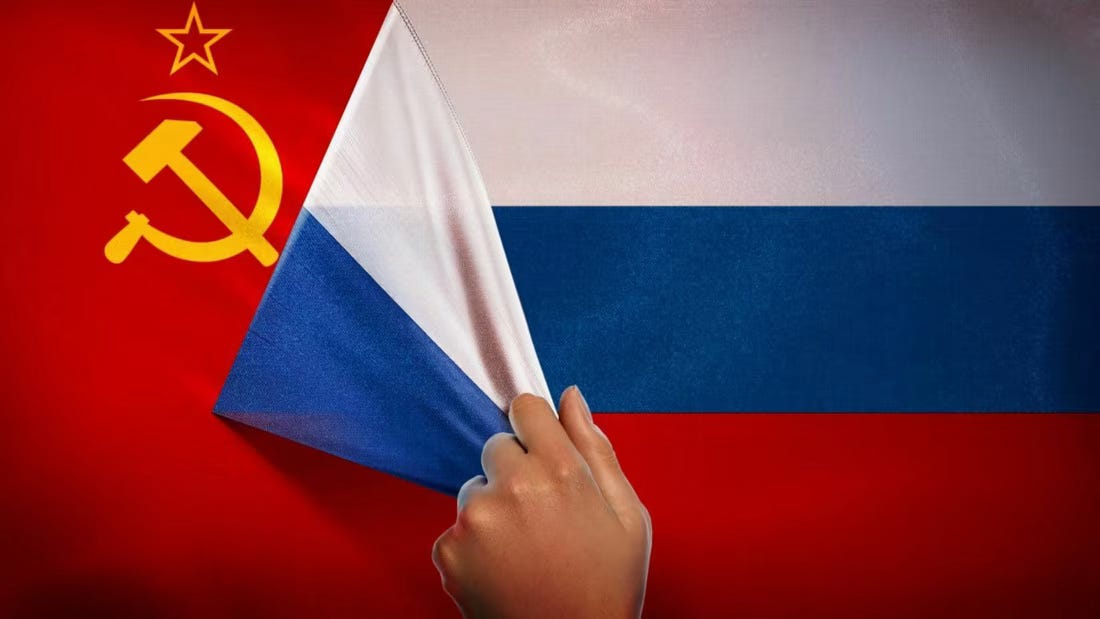
Out with the Old: The demise of the Soviet Union in 1991 and its replacement by the Russian Federation paved the way for a new kind of Mafia state in which kleptocratic oligarchs replaced huge state-owned industries.
Just as the Nineties began, and Donald Trump’s fortunes were cratering (see King Midas in Reverse), something similar was happening nearly 5000 miles away from New York, in Moscow.
Like Trump, the Soviet Union was collapsing.
Trump’s near-death experience meant hanging on through six bankruptcies, nearly a billion dollars in personal debt, a divorce from Ivana, and the demise of several treasured companies he had acquired.
But the Soviet Union fared even worse. Where Trump was on life support financially, the USSR actually did die. It was formally dissolved in late 1991.
And that changed everything—or seemed to. Conventional wisdom had it that the Cold War was over, and the West had won.
But the conventional wisdom was wrong. The Russians were masters at playing the long game, and a new, clandestine phase of the geopolitical standoff between the newly formed Russian Federation and the West was just beginning. What happened next proved to be an astounding boon for Trump.
Prior to the Soviet collapse, Vladimir Putin had been a relatively undistinguished KGB operative stationed in Dresden who saw the demise of the USSR as an epic disaster of historic proportions.

But not long after the Soviet collapse, he took a job as deputy to Anatoly Sobchak, the newly elected mayor of St. Petersburg (formerly Leningrad), and it was the best thing that could have possibly happened to his career.
At the time, huge multi-billion dollar industries that had been owned by the Soviet state —oil, aluminum, natural gas, banking, etc.—were up for grabs. To do business, you needed to have security because everyone else had security—thugs, who liked to fight. It was the Wild, Wild West. And if you wanted to take over the really big enterprises, you needed the Mafia’s help. Outsiders who were unwilling to go to the dark side didn’t stand much of a chance. You needed protection.
As I wrote in House of Trump, House of Putin:
At an extraordinary moment in its history, Russia’s newfound lawlessness became a mission worthy of (Putin’s) enormous ambitions, as well as a gigantic opportunity. At the time, hyperinflation had wiped out the savings of millions of people just as hundreds of billions of dollars’ worth of Russia’s natural resources—gas, oil, metals, timber, and more—were about to be sold off by the state. Food shortages necessitated launching a temporary system of barter operations in which the city of St. Petersburg traded raw materials—oil, timber, rare metals, and the like—with foreign companies for food.
Because St. Petersburg was the first Russian city in which property was privatized, Putin led the way. From his relatively unimpressive perch as deputy mayor of St. Petersburg and chair of the External Affairs Committee (KVS), he was given the mandate of encouraging, regulating, and licensing foreign investment in huge formerly state-owned enterprises. Now that the centralized command structures of the Soviet era were gone, authorities desperately needed new mechanisms to put goods into stores.
All of which meant one thing: Vladimir Putin was on his way to acquiring the power to determine who could become wealthy.
Putin’s ambitions were fueled by the fact that even through the death of the Soviet Union took millions of Westerners by surprise, the KGB had seen it coming and knew exactly what to do.
In anticipation of the USSR’s demise and, even before then, in hopes of penetrating the Western business world, General Vladimir Kryuchkov, who led the KGB until August 1991, had launched dozens of companies run by both KGB operatives and their allies in the Russian Mafia who hibernated until they were ready to rise again. One of the most notable of those companies was Seabeco SA, an investment and trading firm which was founded, according to Belgium’s Le Soir, “as a cover for the Soviet [intelligence] services” by Boris Birshtein. In addition to having ties to the KGB, Birshtein allegedly had a close business relationship with the Solntsevskaya Bratva’s Sergei Mikhailov, one of the most powerful mobsters in Russia.
As author Karen Dawisha explained in Putin’s Kleptocracy, “former KGB, mafia, and political and economic elites joined forces, combining their money, connections, and position to create the basis for Putin’s spectacular success in building an authoritarian and kleptocratic regime.”
In other words, rather than fighting the Mafia, Russian intelligence enlisted them, used them for black operations, and allowed them carte blanche so long as they reinforced the KGB’s power and served mutual economic interests. Where Americans cracked down on organized crime, the Russians co-opted it. They weaponized it. Russian gangsters became, in effect, their enforcers. This is not merely a metaphor.
As Oleg Kalugin, former head of counterintelligence for the KGB, told me, in effect, “the Mafia is one of the branches of the Russian government today.”
As I noted in House of Trump, House of Putin, Boris Urov, former chief investigator of major crimes for the Russian attorney general, put it best. “It’s wonderful that the Iron Curtain is gone, but it was a shield for the West,” he said. “Now we’ve opened the gates, and this is very dangerous for the world. America is getting Russian criminals. Nobody will have the resources to stop them. You people in the West don’t know our Mafiya yet. You will, you will!”
The value of “playing the long game,” was perhaps best exemplified by Boris Birshtein’s Seabeco, which in 1991 and 1992 alone, gave birth to at least six highly profitable joint ventures that clearly understood the importance of having mutually beneficial relationships with strategically placed businessmen—like Donald Trump.
And indeed, a decade later, in the early 2000s, Alexander Shnaider, a former Seabeco executive who was Birshtein’s son-in-law, began to develop the tallest building in Canada, the sixty-five-story Trump Tower and Hotel in Toronto(now the St. Regis Toronto). When it came to financing the skyscraper, Shnaider, a billionaire of Russian extraction, turned to Raiffeisen Bank International AG in Vienna, a bank whose affiliate has been called “a front to provide legitimacy to the gas company that [Russian crime boss Semion Mogilevich] controls, RosUkrEnergo,” according to Scott F. Kilner, deputy chief of mission for the US embassy in Austria.
In addition, the Wall Street Journal reported, Vnesheconombank, or VEB, at the time, bought $850 million of stock in a Ukrainian steelmaker from Shnaider, about $15 million of which went into the Trump Toronto project. (At the time, the chairman of VEB’s supervisory board was Vladimir Putin.)

Mafia ties: A reputed mobster who was said to be close to the Russian criminal group Solntsevskaya and to its boss Sergey Mikhaylov, Mikhail Chernoy and his brother Lev were also involved in Semion Kislin’s Trans Commodities.
The newly rich participants in these ventures included former Soviet citizens who had already reached out to Trump. According to a 1996 Interpol report, Semion Kislin, the alleged “spotter agent” whose electronics shop sold hundreds of TVs to Trump(See 1980 Former Soviet Agent: How Trump Was Lured into the KGB’s Web) was a partner in Trans Commodities, Inc., a firm that was used by two reputed mobsters from Uzbekistan, Lev and Mikhail Chernoy, for fraud and embezzlement.
As I wrote in American Kompromat:
The first real story on Kislin was published by the Center for Public Integrity, a 1999 article by Pulitzer Prize winner Knute Royce that cited a 1994 FBI file characterizing him as a “member/associate” of the mob organization headed by Vyacheslav Ivankov, the “godfather of Russian organized crime in the United States.” By then, Kislin had started Trans Commodities Inc., a firm that, according to the FBI report, “is known to have laundered millions of dollars from Russia to New York.”* Kislin’s firm, Trans Commodities, and Anton Malevsky, a contract killer for the Russian Mafia, were also allegedly tied to oligarch Mikhail Chernoy, who was a major figure in the so-called Aluminum Wars, which were marked by embezzlement, money laundering, and murder. Finally, the report said that Kislin was also a “close associate” of the late arms smuggler Babeck Seroush and that he had cosponsored a visa for Malevsky.
For his part, Kislin was never charged with any crime, and in 1999, he denied any ties to the Russian mob. He has also denied charges that Trans Commodities laundered money for Russian organized crime. When I asked to interview Kislin, he declined, but in an email to me, he again disputed Royce’s story. “I have never known or had any ties to anyone named Vyacheslav Ivankov, and I have never been involved in money laundering, either directly or through any company,”
Meanwhile, Kislin donated more than $40,000 to Rudy Giuliani’s successful mayoral campaigns in New York in 1993 and 1997, as well as to the campaigns of Giuliani allies, and raised millions more for him at fundraising events for an abortive Senate run. Giuliani appointed Kislin to serve on the New York City Economic Development Corporation from 1996 to 2000, a patronage job the mayor reserved for trusted allies.
And that was just the beginning.
Cast of Characters
Boris Birshtein
A Russian-Canadian businessman who founded Seabeco SA with KGB operatives and under KGB guidelines to set up corporations abroad. At Seabeco, he worked with son-in-law Alex Shnaider, who later built Trump Tower in Toronto. Birshtein hosted the famous 1995 summit meeting of Russian mobsters in Tel Aviv, at which Semion Mogilevich was allotted an enormous share of the Ukraine energy trade.
Mikhail Chernoy
A billionaire oligarch who ran Trans-World Group with his brother, Lev, Chernoy won a large share of Russia’s aluminum industry; and acquired a huge stake in processing and distributing other metals and petroleum products. Chernoy allegedly defrauded the Russian central bank of more than $100 million, and is believed by the FBI to be a major Russian crime figure.
Semyon “Sam” Kislin
In the late seventies, Trump bought hundreds of television sets for the Commodore Hotel (now the Hyatt Grand Central) from Kislin’s Joy-Lud Electronics, a KGB front. See 1980 Former Soviet Agent: How Trump Was Lured into the KGB’s Web) His partner at Joy-Lud was another Soviet emigre with ties to Russian intelligence, Tamir Sapir, whose Sapir Organization later financed Trump SoHo. As a commodities trader, Kislin was tied to Mikhail and Lev Chernoy and, according to the FBI, to Vyacheslav Ivankov’s gang in Brighton Beach. Kislin has denied having ties to the Russian mob.
Vladimir Kryuchkov
Head of the KGB until the demise of the Soviet Union, Kryuchkov launched dozens of companies run by both KGB operatives and their allies in the Russian Mafia who hibernated until they were ready to rise again. One of the most notable companies was called Seabeco and a number of its associates ended up funneling money through Trump projects.
Sergei Mikhailov
Alleged to be the longtime head of Solntsevskaya Bratva, the biggest crime gang in Russia, and an associate of Semion Mogilevich, who is said to have laundered money for him starting in 1984. According to one denizen of the Russian underworld, Mikhailov is very much the boss of Solntsevskaya and is more powerful that Mogilevich, who, as the brains of the operation, came up with its most sophisticated financial scams.
Alex Shnaider
In the early 2000s, Shnaider, a billionaire of Russian extraction, began to develop the tallest building in Canada, the sixty-five-story Trump Tower and Hotel in Toronto(now the St. Regis Toronto). Shnaider is also the son-in-law of Boris Birshtein and worked at Birshtein’s KGB-tied company, Seabeco.
If you have tips, leads, or insights, please reach out—I am always looking for new information. And don’t forget to comment and share your thoughts!
Craig’s six books on the GOP’s assault on democracy include NYT bestsellers American Kompromat; House of Bush, House of Saud, and House of Trump, House of Putin. He has written for Vanity Fair, New York, Esquire, the New Yorker, etc.
House of Trump, House of Putin
The Untold Story of Donald Trump and the Russian Mafia

American Kompromat
How the KGB Cultivated Donald Trump, and Related Tales of Sex, Greed, Power, and Treachery

US author explains Donald Trump’s Russia, KGB connections

Craig Unger is an American journalist and writer who has written two books on Donald Trump’s connections to Russia’s security services and the Russian mafia stretching all the way back to the 1980s. Unger says he is “absolutely certain” that the U.S. president is a Russian asset whose current actions are benefiting Russian President Vladimir Putin, and destroying relationships with long-time allies
And from 7 years ago :
CNN analyst: 18 reasons why Trump may be a Russian asset

Trump is a notoriously prickly, litigious character. Yet he has not sued Ms Hill, Mr Unger or CNN.
For the avoidance of doubt, Ms Hill, who worked for him, does not say he’s an asset, but does make some serious allegations.
The others are clear : Trump is a Kremlin asset.
“The Russians cheered in the streets when Trump won his second term. They considered Trump’s victory to be a Russian victory.”
It certainly was.
Krasnov’s first wife’s father was a KGB informant. A file would have immediately been opened on him.
The contents by now will be enough to fill a small building. Now we can add all the stuff that ruZZian agent Epstein gathered on Krasnov which is yet to be released.
Ivana certainly had lots of damaging info on Krasnov. She was an athletic woman with excellent balance; it is virtually impossible to imagine that she fell down her stairs.
Krasnov now has an excuse to expedite his long held desire to leave Nato.
The Iran shitshow might even have been the primary motivation. Learning from putler and OrbanaZi, Krasnov may be planning to keep his pro-putler party in power by nefarious means.
As stated in a previous post, Krasnov made his Europe policy clear last year in a policy document.
“Patriotic Parties” : meaning of course Fidesz, Afd, National Rally, Reform etc, will be targeted and relationships strengthened; a process that was commenced by Bannon.
All these parties are pro-putler.
Krasnov is building a pro-putler/anti-EU/anti-Nato alliance.
A new axis of evil.
I am convinced that the orange gangster is a russian asset. Not only that, he is a russian MAFIA asset. Allowing the russians to help Iran in their war with Taco WITHOUT ANY CONSEQUENCES is perhaps the best possible proof.
He’s a ruSSian and an iZraeli asset.